
We’re out!
These trainers, surprisingly, are easy to dodge. One of the odd moments the game doesn’t mess with you. Imagine getting out of a tunnel low on heath, then having to go all the way back because your pokemon can’t face the trainers ahead.

And now we’re in Lavender Town.


So they really don’t do any other fancy sprites. I guess the ones I saw early on left such a mark that I just assumed they’d updated the pokemon in general, but nope.

Got plenty of money, so time to address that. I need some greatballs and…

The best way to avoid having Pikachu faint is to be able to revive others and throw them back into battle.


Wow, I forgot Pikachu is already terrified by the first floor. Nothing’s even happening yet, Pikachu!


Come to think of it, the fact he lets you get so close before noticing you is another point in favor of the dead rattata theory, isn’t it.


Ah, the joys of being underleveled. His fearow already knows mirror move and is reflecting my own (missed) attack back at me. I have no idea if mirror move can be used strategically, but it’s really fun.

Gary really doesn’t seem worried I started with an electric-type, does he?


Shame the AI is so stupid. And I think his eevee really needed to be leveled up more, especially given that if it was a standard starter it’d have evolved once already.

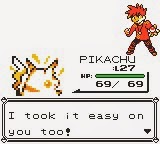
He actually did, game. Be harder!

Well, so much for Gary. Wasn’t that fun, Pikachu?

Oooh right. Sorry. Let’s get out of here.
I’m pretty sure Pikachu’s happiness isn’t affected by being kept here, but it should be. Just look at that face! Anyone who forces Pikachu to stay here is a jerk.
On toward Celadon and the Silph Scope.


It’ll never work again so I’m taking advantage of this while I can.


So I killed my paras for some stat boosts. Sorry.
Now to catch some new “friends”.

And take advantage of this feature while I can too.
The pokemon found here are interesting.


See, originally this was full of version-exclusives, but Yellow does those differently. So instead, there’s something else here.

Besides my bane.

These abra are higher level than they need to be to evolve. On the other hand, they’re super speedy and always teleport.

Some high level jigglypuff too.

YAY

And here we go!


Although kadabra are easier to catch, in that they have moves other than teleport, they still have this move until L27…which is also the highest level you’ll see them at. So, if you can’t manage to work around their teleport, you can still get one at the cost of a more difficult fight.


Thank you mirror move.


YES!


Fanfic should be ashamed it doesn’t incorporate more of this flavor text.

In conclusion, here’s Clefairy’s L20 stats. Seems clefairy have better special than you’d think. I should find TMs for it.
“but Iran has always been hyper cautious”
I think your text glitched too!
aaaaaaaaaaarrrrrrrrrrrrrrrrggggggggggggggggg how did that even happen.
Clocks running backwards around the psychic/magical actually comes up in this game I played, Arcanum: Of Steamworks and Magick Obscura. It’s actually one of the best narrative RPG’s I’ve ever played, with stellar character building and a wonderfully-constructed world. Magic exists in a Victorian-Industrial Steampunk world, but the two forces are at odds (magic alters physics to work, technology harnesses physics to work). It’s a stunning example of social commentary and, I mean, it’s just kind of ridiculous how the setting and characters work in a setting not unlike a warped Dickens novel.
edit: I can’t really praise the game without devolving into incoherent gushing, but it’s really good.
It is less clocks running backwards and more magic just generally fucking with technology, though.
Which I don’t really like because you know what else runs on the laws of physics? Everything. Including human bodies.
Technology is not some arcane power, it is merely the way to use processes that always existed for your benefit. That’s the whole point. Treating it as some kind of power in itself capable of fucking with magic back contributes to the perception of technology as something arcane, which is a bad thing because the whole point of it is that technology can be used by anyone and can be created by anyone (well, in theory, anyway).
And it’s not like the dichotomy is really even needed. You can totally make the conflict between magic and technology purely social. Magic is exclusive. It gives personal power to a few individuals, so they can use it to get what they want. Technology is inclusive. It gives power to the masses. At least when it’s mass-produced. From there, you can easily start a conflict between a few individuals with enormous power and great numbers with riffles.
Which Arcanum actually does, so the whole dichotomy is kinda pointless.
It is still a good game, though not without its flaws, it’s just that this particular facet of it is not the best part.
Yeah, the fact that magic’s infringement upon physics solely affected technology was one of its more poorly explained points, but I felt that it was more or less adequately explained by the fact that many creatures were intrinsically magical, or at the very least not sensitive enough to the whole magic vs. tech war to feel anything. In the far distant past the world had a sort of extinction event linked to magic, and historians suspected there was a “supernatural evolution” resulting from that event. It just made sense to think that all living things had adapted to a magical world except for dwarves, who lived deep underground and developed technology.
There are magics that specifically harm one or more creatures, so the sense that I got is that magic as a whole is just this extremely directionless force that is basically harmless until someone gives it an order.
It’s still insufficient, in my opinion, but that would explain to me why technological aptitude gives people a kind of aura: it’s because the baseline level of magic isn’t reaching them. Sort of like DnD, positive energy versus negative energy. Technology gains power through its natural expulsion of magic in a magical world. That’s why magical aptitude lowers around the train station.
In general I suppose you’re right; it’s a show-don’t-tell problem in which technology is capable of feats just as ridiculous as magic, and certainly doesn’t act much like technology in our world, but that’s a limitation of the medium. I really felt by playing the game multiple ways, and deciding that the game is extremely unbalanced in favor of magic, that technology was still the more generally inclusive faction, as you say.
Speaking of, Arcanum took rather great pains to show that technology wasn’t as inclusive as it liked to claim to be. I felt that was a great parallel with actual society, because Tarant still split into a very clear have/have-not pyramid, with labor disputes and classism etc.
What is the best part of Arcanum, if you don’t mind me asking?
“Technology gains power through its natural expulsion of magic in a magical world.”
That’s the thing, though: there isn’t any power in technology. Technology is just a method to use natural resources in creative ways. When you bash rocks against each other to sharpen them and create a crude knife, you are creating a piece of technology. Combustive engine is exactly the same, the only difference is the scale.
And the first combustive engines and firearms were really simple. If magic is capable of fucking with them, it should be capable of fucking with just cooking something.
The technology as imposition of laws of reality upon the world could work, but this way lies postmodernism, Mage: the Ascension style. It also doesn’t exactly fit the world of Arcanum as you don’t really see rocks falling into the sky when the wind blows the wrong way.
“Speaking of, Arcanum took rather great pains to show that technology wasn’t as inclusive as it liked to claim to be. I felt that was a great parallel with actual society, because Tarant still split into a very clear have/have-not pyramid, with labor disputes and classism etc.”
Yes, that is nice. While technology has a potential to uplift the masses, it was often used through history as means to control. High tech, low life and all that.
“What is the best part of Arcanum, if you don’t mind me asking?”
It’s been awhile since I’ve played the game…
I guess I liked the sense of the world changing, the contrast between different cities. That’s something many stories miss: the world is never static. Everything changes and you can’t really stop it, just adapt to new circumstances.
I also liked the way Charisma allowed you to recruit more characters. By the end of the game I was in charge of what? Ten people? Twelve? Either way, during battles I typically stayed aside, shooting from a revolver towards the enemy and watching my personal army stomping over opponents.
That was surprisingly cathartic, especially since many RPGs don’t put much value in talking skills.
I guess connections are everything in this world.
“That’s the thing though: there isn’t any power in technology. Technology is just a method to use natural resources in creative ways.”
I agree that this is certainly how technology works in our world, but it’s not too much of a stretch to imagine that magic is subtly fucking with everything in the world, including cooking, and that stronger technology is the only thing that can stop it. It’s a mistake, in my opinion, to make too strong a connection between our technology and Arcanum’s, because steampunk has rarely been more ridiculous and overblown. I would go with your Mage; The Ascension example. Technology forces physics to work even better, where “better” means “more suited to high-technology.” That’s why you could have Vendigroth, an ancient civilization of high technology.
“That was surprisingly cathartic, especially since many RPGs don’t put much value in talking skills.”
The talking skill in an RPG gains relevance and utility in proportion to how much the story matters, I’d think. That’s why the late-90’s narrative RPG’s generally had beautiful stories and excellent diplomatic solutions. Arcanum is partly a love-letter to Fallout, one of the first games where you could even talk down the final boss (just as you could in Arcanum). Planescape: Torment even takes it a step further, in that talking your way through the game is unambiguously the best way to play.
I too highly enjoyed the sense of change and progress that Arcanum’s world had. I feel that what many games and stories in other mediums often lack is that conflict that comes with sense of progress. One great example in Arcanum itself is when you’re on the Master Persuasion quest: a new city-state is trying to join the Unified Kingdom, and your quest is to negotiate terms beneficial to the UK (hah). You really see how the ruling interests want to move the world in a direction they desire, and how much gets trampled over if they completely get their way.
“I agree that this is certainly how technology works in our world, but it’s not too much of a stretch to imagine that magic is subtly fucking with everything in the world, including cooking, and that stronger technology is the only thing that can stop it.”
It is a possibility, but that should’ve been established better, in my opinion.
I’ve seen far too many magic vs technology conflicts to buy into it without a good explanation.
At least Arcanum doesn’t go the “technology is unnatural” or “technology destroys imagination and creativity” routes.
“The talking skill in an RPG gains relevance and utility in proportion to how much the story matters, I’d think.”
Nah, the reason talking skills suck most of the time is because instead of rewarding you with additional content for choosing diplomatic options games often take away content from you by skipping over interesting fights or quests.
Planescape: Torment is indeed the best game to go for good dialogue. At a cost of an awful battle system and not very impressive magic (barring a few spells that basically break the game because who needs balance?).
Fallout is a middle ground, I think. Social skills are integrated into the gameplay well enough, but sometimes they still present a more boring option. And you still need some fighting ability.
“Fallout is a middle ground, I think.”
Fallout speedruns rely on the Speech skill, from what I’ve seen. But in the course of normal gameplay it is rather more supplementary, true. You often use it to gain a larger reward or some kind of advantage in a fight, if not bypass the fight altogether. It’s not the main course like in Planescape: Torment, which I won’t say anything about except to mention that my desktop wallpaper has been the Symbol of Torment for the last five years or so.
“Nah, the reason talking skills suck is because… games often take away content from you by skipping over interesting fights or quests.”
I feel like this is true to a degree, but I still feel like the importance of the narrative plays a large role. As you said, Planescape: Torment had an irredeemably bad engine and combat system, but the story, dialogue, and setting were just glorious. A Persuasion playthrough in Arcanum doesn’t feel boring, either. You don’t really have to lift a finger in combat if you don’t want to.
I believe that the phenomenon you’re talking about occurs more in later RPG’s, like Bioware’s or Obsidian’s. This is partly because game engines and programming advanced enough to make fighting really fun, but the writing didn’t always keep up, so there was no point in skipping the awesome battles and set pieces just because your character happened to be uncommonly witty. Dragon Age is a good example. Any really important fight is going to happen pretty much no matter what, and the best the persuasion skill can really hope to do is ensure you a better reward for the fighting you’ll inevitably do. Though Dragon Age isn’t a perfect example, since I specifically recall a quest or two in which a persuasive character got a better reward without fighting (the reward was Blood Magic Specialization, which was almost impossible to obtain elsewhere).
Popping in to say as someone who loves playing with a high-talking-skill characters, I thought Dragon Age did a good job of this. Attempts didn’t always work (I never got the deth-penalty-qunari dude because I couldn’t persuade my way to it) and generally the options it opened up were equally as rewarding. You also didn’t skip major battles, but could instead use it to determine whose side you were on and who was on your side. There were a handful of instances where it got a little cheap, but overall I quite liked it.
If you want to talk about bizarre implementation: Oblivion. That was an incredibly… just bizarre speech-skill mechanism.
You never got Sten!? That’s the saddest thing; he’s one of the best characters. He was all stoic sarcasm with a gooey center. I never played Oblivion, though I’m told it was… a thing.
Also you’re a mod, and it’s sort of too late to look back and ask, but is this kind of off-topic discussion in the comments section encouraged? Because we are so far from Pokemon Yellow I’m almost thinking we can loop back around and theorize what the Pokemon games would be like with the Speech skill…
No, and I was really sad! I need to do a playthrough focused on Sten and Zevran, as my usual goody-two-shoes first-go kind of ended up missing their stories.
We don’t really have any rules. My modly duties entail approving stuff that accidentally gets caught in the spam filter when Farla doesn’t do it first and… having a cool flair. Talk away!
Word. Well, I’ll be reading along with your F/SN LP (and I will probably re-read the entirety of UBW because I miss it), so let me thank you in advance for the thoughtful and compelling reactions you have to it!
Yes, I saw your comment and as always came up with my response and then forgot about it.
Thank you! That people get something out of what I have to say is as always a surprise and delight.
Speaking of FSN, I am really looking forward to your reaction on the grand reveal this route.
More even than I looked forward to your reaction on the threesome.
I’m looking forward to Act’s reaction of the end, after the final battle.
You missed Sten? For shame, he’s a cool character. Especially if you are a mage, as is right and proper.
I am actually pretty sure that you don’t need specific skills to get him. I suspect that you missed some dialogue option or something.
“I believe that the phenomenon you’re talking about occurs more in later RPG’s, like Bioware’s or Obsidian’s.”
Nah, it happened in old games just as well. Check out Temple of Elemental Evil, by the same company that made Arcanum. There were a few options for talking, but they mostly consisted of you skipping fights and therefore losing potential XP and loot.
Or go for Baldur’s Gate. The game is good, the story is good (especially in the sequel), zero persuasion, however.
Yeah, I haven’t played those, so maybe my perception is colored by the ones i have played. Baldur’s Gate 1/2 is next, once I get around to it. I’m told they use the Infinity Engine though, which, I mean, is just… ugh.
They are so-so in terms of gameplay, but massively better than Planescape. Sometimes you even need to use tactics.
Amusingly, the first game is better than the second. Lower levels, dangerous enemies. You actually need to think about how you would approach problems.
The second game is not too bad, but nothing special either. Until the add-on, anyway, it does crank up the difficulty considerably.
The biggest problem I’ve faced, however, was the guy who appears if you kill Drizzt (yeah, he’s in both games. Killing him is hard in the first one, but very satisfying. He’s easier in the second one, despite having a party of his own, but it was still nice to kill him. I have my own drow, and she’s better than him, anyway).
The guy in question wanted to take my stuff which I rightfully claimed from Drizzt’s corpse. And he’s immortal. Asshole.
So, I hid away most of the stuff I’ve took with an exception of the least useful thing. He took it and went away, I took the rest of my stuff. Then he appeared again to take my stuff. Asshole.
I used the trick the second time, losing a more valuable thing this time around. He went away, but then returned the third time.
I really want to find a mode that allows you to kill him now. This time around, however, he didn’t try to take my stuff, he just cast the Imprisonment spell. Which locks you away. If your main character is hit, it’s the game over. Fortunately, I had means against that, as the tactic is also used by one nasty optional boss. So, he cast a spell, I lolnoped it…
And he was just staying here, doing nothing. I tried to hit him because it was the first time I was able to do so, but he didn’t react. Well, I went on my business… Only to meet him in the next location. And the next. He was just staying here, near the entry point, doing nothing. No dialogue for him either. This time around, when I hit him, he multiplied. And when I hit the clone, he multiplied too.
That was a rather surreal experience.
Funky. I know BG1/2 use either DnD 3 or 3.5, which is another reason I’m rather leery of playing them: I know the early game is going to seriously suck since I’ve actually played tabletop DnD and I’ve struggled with the whole <10 HP and 1-2 spells per day thing. I really hope the leveling is well-paced.
If the game really has some good tactical challenges, that'll be a plus, but I basically play old RPG's for the story these days. Technological improvements haven't directly translated to better games, as far as I'm concerned, but I have to admit that games have become much less of a hassle to play (which is nice for simpler, action-oriented games like Demon Souls/Dark Souls). In fact, the Souls series is the example that I would point to if I were to say that the trend towards minimal story and greater emphasis on action is not such a bad thing.
No, they use AD&D 2E. BG2 does bring in some stuff from D&D3, most notably Sorcerer class, but the core remains 2E.
Which doesn’t exactly improve your problem. 3E at least tried to address the issue by giving you additional spells based on your casting stat. Not so in 2E. First level wizard literally has one spell per day (if you are a generalist. Specialization adds an additional slot).
It’s not a problem in BG2, though: the game starts with you being around 7 level if you are a caster (AD&D used different XP progressions for different categories of classes), so you have a solid arsenal of spells from the beginning.
BG1, though… Yeah, I slept a lot.
If you are going to play them, here is an advice: summon spells. They are your friend. Especially animating the dead by clerics because skeletons mesh well with some area spells.
I actually had an awesome moment in the first game. A necromantic stand-off.
You see, the AI navigation sucks in those games. You probably experienced it in Planescape. If you make a mistake of just telling the characters to go to some remote spot on the map, it is guaranteed that at least one of them will go in territory unknown and probably get eaten by GRU or something.
In my case, it was my drow cleric, who is pretty awesome, by the way. In her travel, she stumbled upon some evil cleric in the middle of some dark ritual. After the usual banter, he summoned some skeletons.
Well, I summoned skeletons too, because they are great. Then he used some buffs and I did the same.
In the end, two clerics were battling with maces as skeletons around them were fighting each other. Occasionally either of us bashed the skull of enemy’s minion who happened to be nearby, causing them to explode into a cloud of bones.
That was pretty cool, probably one of the more memorable moments.
While the evil cleric had some backstory of his and a side-quest attached (of which I was unaware when I met him), I like to imagine that that was just something necromancers do when they meet each other away from prying eyes.
Necromancer Postulate: I’m up to no good, so other necromancers are up to no good, which makes it okay to kill them.
Random moments like this, not supported by the narrative but still cool is what I really remember from old RPGs, now that I think about it.
I remember how in Fallout 1 I made my way to the mutant base. I had a few companions with me: Yan, the dog and some guy in battle armor. As I was getting near the base, a random encounter with mutant patrol started and the dog was killed. I didn’t save in some time, so I decided, fuck it, I am near the end anyway. So I went ahead.
At the base itself, Yan was killed a few meters away from the entrance. As I didn’t manage to save before the start of the battle, I went ahead afterwards.
You may remember that the base is riddled with force fields. Some of them you can go through without troubles, but they do some minor damage. The guy in the armor was low on health, but I figured I can go to the next room before giving him stimpack.
The force field somehow managed to critically wound and kill him.
And by that time I realized that it makes for a surprisingly good narrative considering the setting: I’ve lost my comrades one by one as I was getting closer to my goal.
When I reached the main computer, I was alone, and afterwards I went to meet the Master not so much to save the Wasteland as to get revenge.
Fallout 2 wasn’t quite that appropriately dramatic, but there still was a nice moment, also near the end of the game.
You see, F2 was one of the first RPG games I’ve played. And I sucked at it. Instead of building my character with any sense of purpose, I just placed skill points in whatever skill seemed appropriate for the current task. Same with perks.
I managed to beat the game reasonably fine, but the final boss easily kicked my ass in one turn. No matter what I did, I could not defeat him, not even with the help of turrets and those Enclave guys you can recruit for help.
So, reloading for the tenth time, I went through my inventory. As a good aspiring munchkin, I collected all manner of useful things I’ve never used.
Including fuckton of drugs.
Which I used on my character. All of them.
By the time I faced the final boss once again, I was God among men. Between 10 in three or more stats and 99 action points, there was no chance for him to beat me.
By the time all was said and done, however, side effects of drugs kicked in and reduced my intellect to the point where I couldn’t speak with anyone. The dialogue just presented me with nonsensical options which instantly closed it.
Such is the tragic tale of the Chosen One who burned his brain to defeat the great evil.
The followers in FO1 were added at the very end of development and were not intended to survive the endgame (though it was possible to keep them alive). But yes, the strange encounters and sidequests made the game, no matter how good the primary narrative was. FO1 had extremely minimal design; it was a very tightly-constructed game. Even so, it managed to give a ton of freedom and extra content to those who looked for it.
What really stood out to me in this regard was The Glow. You weren’t strictly required to go there, but joining the Brotherhood was a very obvious thing to do. Even so, the Joining quest only required you to search the first level for the holodisc. There were 5 more basement levels below that, each with its own significance, especially the level with the supercomputer who would tell you about the war. The rewards for fully searching The Glow (assuming you didn’t die) were incredible. Armor, weapons, backstory.
“The followers in FO1 were added at the very end of development and were not intended to survive the endgame (though it was possible to keep them alive).”
Yeah, they were pretty meh. I mostly used them as walking backpacks, which is the duty of all companions not directly controlled by the player in all games where the weight of the junk you carry with you is an issue.
That still made for a surprisingly compelling narrative with them dying one by one as I was making progress towards end game.
“Even so, it managed to give a ton of freedom and extra content to those who looked for it.”
That was always the strong point of Fallout games, even the later incarnations*. The main narrative is fine, but the side-quests and exploration is what you should really look for.
*Though I mostly dislike Fallout 3. With an exception of this old guy who sits in that tower ghouls want to invade and shoots everything that moves, according to him. I like old merry badass sociopaths, a character archetype sadly underused in media.
“That still made for a surprisingly compelling narrative with them dying one by one as I was making progress towards end game.”
Oh, absolutely. I feel like more game designers need to use this concept. Too many RPG’s treat the player and his team as invincible gods.
edit: By which I mean, they never die in gameplay, only in dramatically-appropriate cutscenes. That’s not the way to do it. That doesn’t put any of the weight on YOU, the player. It completely removes your impact on the narrative.
“Though I mostly dislike Fallout 3.”
I heartily dislike Fallout 3’s main story and everything associated with it, and I was less than fond of certain changes they made, like making Power Armor require training to wear, and basically anything that curtailed freedom. The game was pathetically easy and it was barely an RPG because your stats dictated so little.
That said, Bethesda did get some things right. The world was vast and filled with wonderful, wonderful secrets. Every vault that wasn’t associated with the main quest (101, Braun’s Lab, and the GECK vault) was absolutely wonderful, either because it was bone-chillingly scary or hilarious.
“That’s not the way to do it. That doesn’t put any of the weight on YOU, the player. It completely removes your impact on the narrative.”
To be fair, the alternative would be either just annoying as you would reload the game every time someone died or actively frustrating if a favorite character of yours died in the middle of nowhere.
The death of my companions was meaningful for me because it contributed to the narrative, but it was a coincidence.
If, say, Morrigan could just die in an ordinary battle with no chance of reviving her, I wouldn’t be pleased.
Yeah, that’s true. There are plenty of valid reasons for invincible companions. The problem is that there’s an extremely delicate balance between “likable companions” and “meaningful companion death” that is almost impossible to make on purpose, and it’s more likely to happen on accident, as you experienced.
I didn’t really think of the whole save/reload thing, and to be honest it’s one of my least favorite parts of RPG’s, because it encourages tedious and pathetic behavior on the part of the player. When I play I try hard to only reload on deaths, but I often don’t manage it. Being forced to work with the consequences of your actions is tough in a game that encourages freedom. The companion death dilemma is just one aspect of that.
I think basically only RTS games encourage you to actively sacrifice units, which is a shame because there’s a lot of emotional potential in sacrifice, as Act pointed out so well while reviewing Fate. Man… I was both sort of tempted to defend Shirou but also scared to. Gotta remind myself that it was Fate!Shirou.
The answer to that is to create long-reaching consequences. If the decision you made will come back to haunt you ten hours of playing later, you aren’t going to reload the game to avoid it.
The problem is to not create consequences that seemingly punish the player for choices we made, but rather reward any choice with the unique narrative, even if it isn’t exactly happy narrative.
This is difficult, naturally, but I think possible.
I mean there are problems with the long-reaching consequence approach too: they make people go online and use guides, which, I believe, should be Bullet Point #1 on How to Design Games: Don’t Encourage External Information.
The problem isn’t about creating consequences or rewarding choices (the two are basically opposite sides of the same coin). It’s about encouraging players to accept the results of their choices/mistakes, good or bad, or the whims of the RNG, and move on. It’s really hard because gamers are a naturally-entitled species. They bought or somehow acquired the game, they’re using it for entertainment so it’s not like they’re forced to play, etc. People walk away because games are hard, or confusing, or just fuckin’ visually unappealing. I suppose they’re like books in that way, though society usually gives you reasons to read a book.
I think the easiest way of handling consequence is autosaving – assuming a chaotic enough game, and making sure mistakes don’t make the whole rest of the game harder, people will just play and take their lumps. The big issue there is making sure the game is balanced properly, otherwise you have to use a guide or fall behind.
Also about character deaths specifically, what if you got exp when they died, so keeping them around is more of a hard mode narrative play?
Autosaving is part of the solution. Dark Souls is the last autosaving game I remember playing, but reward/consequence isn’t a huge part of Dark Souls, since the whole shtick is to have infinite lives for a hard game. It doesn’t help many RPG’s though, since it will only work when you enter a new zone, so people will still save -> enter dialogue -> fail at dialogue -> reload, or do some sort of skill-sensitive thing and fail/reload. Continuous autosave that doesn’t let you do a thing without saving is scary to some, but I find it fairly appealing. It has its own share of problems.
Your idea for party-member deaths is interesting; I hadn’t really considered having some kind of reward for letting them die. Experience isn’t the reward I’d pick, since RPG’s tend to throw experience at you, but party members are scarce and usually cool/appealing. But I could see some kind of bonus working well enough, yeah. Experience would work in some kind of RPG where for some reason it was extremely scarce, like Bioshock’s Little Sisters.
Perhaps your comrades, like in Fallout’s, are nowhere near strong enough to survive the mid/endgame under ordinary circumstances, but there are narrative set pieces in place (cut-scenes, etc.) that make the player understand it’s not the end of the world. I dunno.
The problem with death of party members is that it’s hard to meaningfully incorporate the possibility of random death into the narrative. It creates too many branches and pushes companions on the periphery of the plot as they can’t be the sole source of plot-important information.
Hm. Well, you could have only major fights be fatal – have bosses that attack downed characters while most enemies move on to those still upright, say. And it should work okay in a minimally scripted storyline, or if you have to complete the character’s storyline before you can bring them along with you on unrelated adventures.
Fire Emblem has characters who play an indispensible role in the main plot get permanently wounded instead of dying. They can no longer help you on the battlefield, but they’ll still be there for their scenes. In some cases a character has just one or two important parts to play early in the story and prior to those KOs will result in wounding, but after them they’ll result in death.
As far as restarting every time a character dies not necessarily being the best thing to do for gameplay reasons, the workaround for that is just that there are LOTS of characters, including multiples for each class, so no one is entirely indispensible. You can always train up another sniper — but they won’t be THIS sniper, who has a name and a backstory and unique relationships to the other characters. But if you’re *this close* to beating map a that’s been getting the best of you over and over, maybe that’s a sacrifice you’re willing to make.
Unfortunately, in the default mode of the newest, shiniest game in the series, the maps are easy enough that this basically never happens. If I ever replay it, I’m definitely playing it on hard. There’s also an option to play without permadeath all together. Prior to getting into the series myself I thought that sounded like a good idea for making the game more accessible, but one playthrough of an earlier game was all took to make a true believer in the classic Fire Emblem experience out of me. Accessibility isn’t the POINT, damn it! Playing a war strategist in *a world with consequences* is the point!
That sounds just about perfect. I need to check out the games sometime.