Last time, I gave an overview of my thoughts on Fire Emblem‘s core gameplay mechanics. Now, I’ll begin giving my thoughts on individual entries in the series. This will be more focused on writing and aesthetics, though I will also discuss unique gameplay elements when they come up.
I began at the beginning, of course, though where applicable I played the remakes, because I don’t hate myself.
Fire Emblem: Shadow Dragon (& the Blade of Light) (NES/DS)
The noble prince is betrayed by the allied kingdom and forced into exile (read: a cushy island vacation with his other royal allies). He must now cut a bloody swath through the land to reclaim what is rightfully his and also stop the evil empire headed by a spooky dragon man who wants to destroy the world because evululz.
So not the most inspired of plots, but well, it was 1990. The remake at least does a decent job of characterizing Marth as a genuinely nice guy, but that’s about it. Unfortunately, the remake also chose to use weird, stiff, claymation-like 3D models over the beautiful sprites of the GBA games, which I can only see as a downgrade.


I mean, just look at it. There’s no contest here.

This is also the game that gave us the OG 1000-year-old dragon loli, Tiki, but in this case I am willing to give the designers the benefit of the doubt that she was genuinely just supposed to be a cute kid. (She shows a lot of leg here, but that’s just the art style; here is Marth’s equally panstless artwork, for comparison.) There is no emphasis on her “real” age; she is stated to have been kept isolated and asleep for most of her long life, so she is actually mentally a kid as well as physically. Her subplot emphasizes what she’s supposed to be when she grows up, and that the only reason she’s fighting as a kid is because the villain’s machinations forced the issue. This is also the only game to feature a playable male dragon, who is a withered old man in human form whose only purpose is to recruit Tiki because it turns out she’s his granddaughter; otherwise, you have to kill her in a very difficult boss fight. I thought this was sweet, and rewarded you for protecting a sad old man the whole game. Her relationship with Marth could be interpreted as romantic if you really torture it, but I couldn’t read it as anything but paternal, especially given he already has a canon love interest.
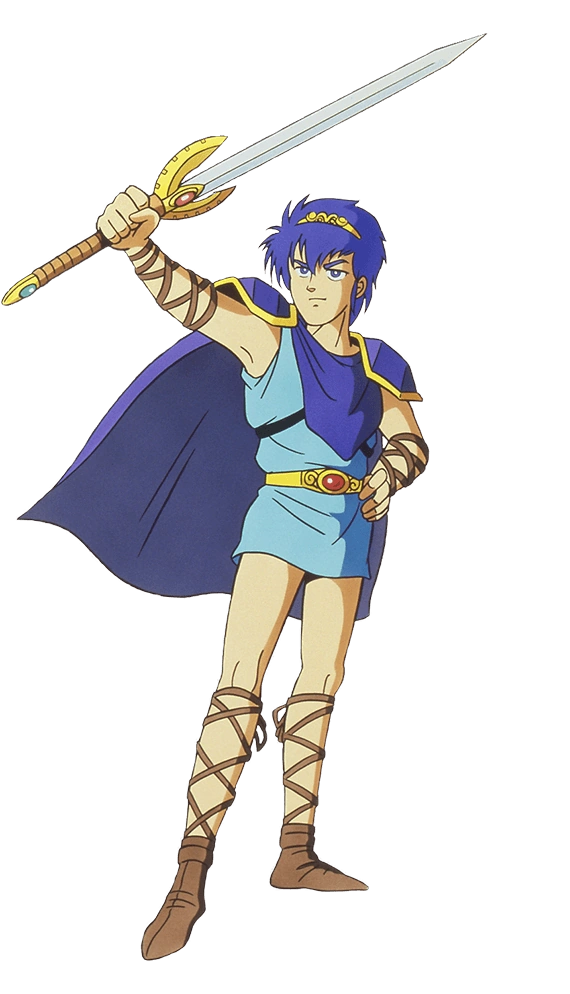
The gameplay here was… fine? I found it quite easy and rather boring, though this was apparently the game that introduced super-high difficulty levels for the hardcore. I have not tried them. The final map was a massive difficulty spike with a lot of surprise traps I found rather unfair, but, well, if you’re going to have a difficulty spike the final map is the place for it.
Marth sucks as a combat unit, which is a problem because Marth is one of only two characters who can fight the final boss (the latter of which can permadie), so you better have been power-leveling him. (Apparently on the higher difficulties he actually can’t survive a round of combat against the final boss even at max level, which, lol.) I’m told this was not a problem in the NES version because the weapon triangle did not exist back then; they added it here without altering enemy comps, leading to a deluge of lance-wielding enemies against which Marth is as effective as a wet noodle. Oops.
The game does one thing I found genuinely interesting: You are not in fact guaranteed to get the hero’s magic sword of specialness. Doing so requires you to complete a long quest chain which can be permanently failed at every step, but I believe it’s fair play because every step is explained to the player quite clearly. You’re told early on that the sword is in the possession of The Evil Sorcerer™, but to defeat him you need a special spell that can only be made with special MacGuffins, and you’re reminded of this both before and after the map where you can miss said MacGuffins. This is also reinforced by throwing The Evil Sorcerer at you midway through the story, not just telling you he’s invincible but showing you through gameplay. It’s a surprisingly complex and sophisticated sidequest, and one that requires you pay attention to the story and all the items on the map. Moreover, the remake is actually quite graceful about saving you from a softlock: If you miss both the sword and the other character who can fight the final boss, you’re sent to a special map just before the final chapter that hands you a strong character and a weaker version of the sword, ensuring you still have a chance. We won’t see anything similar (or at least, similarly well-executed) except in this game’s sequel, sadly.
Fire Emblem: (New) Mystery of the Emblem (SNES/DS)
…Which is this! I liked this one a lot better than Shadow Dragon; it was way harder but also made permadeath toggleable, which was a welcome compromise. This is a game that clearly expects you to have played its predecessor, as it starts full throttle with some intimidating early maps while also handing you many overpowered characters from the first game, giving you the tools to overcome the odds if you know how to use them. The story, too, hits the ground running and expects you to be familiar with the characters of the previous game and their relationships; fortunately, there’s an in-game codex that details both of these, a feature I’m surprised more games don’t use.
The plot was clearly made post-hoc (by their own admission, the devs didn’t expect Fire Emblem to become a series), but manages to be a lot more interesting than the first game… at least at the outset. The hero’s best bud who helped him in the last game has suddenly turned evil and is now hellbent on conquering the world! Could this be because empires are inherently bad and power inevitably corrupts? No, he was just being mind-controlled by The Evil Sorcerer, who somehow came back to life after we killed him in the previous game. The Evil Sorcerer also has the exact same motivation of resurrecting the spooky dragon man, which he does, again, so you have to fight him, again. Then Marth, unsatisfied with merely being a king of one country, is offered the position of god-king of the entire continent, which he graciously accepts. So yeah, the ending is really dumb; but up to that point I found it a genuinely engaging political conflict, with Marth forced to accept his friend has turned evil and must be stopped. Since many of your allies in the first game were from the empire, you’re forced to fight against them, too; you can still win them over to your side, but it’s much harder this time.
Also, there’s a female armor knight this time! She sucks and joins real late, but it’s cool there is one!
The remake is also the first game to introduce a player character, and… I’m ambivalent about their role. Some scenes make it painfully obvious this character was crowbarred into an existing story, with the plot slamming to a halt so everyone can ask you your very important opinion. There’s also a frankly embarrassing amount of PC-worship; not only does Marth immediately latch onto you as his bestest and most important confidant, there’s an entire subplot about a blatant waifubait character who does nothing but worship the PC. I generally didn’t hate the PC, but I don’t feel they added anything either, and the waifubait character was really cringe. (I liked the rest of the assassins subplot, though — they were genuinely menacing and provided difficult fights, and I’m a sucker for slowly winnowing down a recurring villain group over the course of a story.)
Since it annoys me, I also want to mention that there’s a subplot where you have to rescue some damsels through the power of love… by which we of course mean romantic love, because that’s the only love that matters. Sorry Marth, your sister doesn’t love you enough to break out of mind control! Only one of the damsels can be rescued through familial love, and that’s only because she’s such a minor character they didn’t bother giving her a love interest. From a gameplay perspective I can understand why they did it; Marth is always available so if he could rescue Elice it would be too easy, and Matthias is such a useless and easily missed character there would be little point in making an alternate conversation for him and Lena. But it still irks me.
The story also adds a lot of additional lore about the dragons and their history… which the game proceeds to ignore when it’s inconvenient, making me wonder why it’s there at all. See, it turns out Spooky Dragon Man wasn’t being evil for no reason — he only hates humans because they, uh, genocided his people. But he’s still a bad guy who has to be mercilessly killed, don’t think about how he’s actually justified. The only acknowledgement this is messed up is that Marth says “Wow that sucks, sorry that happened to you,” to the Exposition Dragon who explains this, and then it’s never mentioned again.
Just… why is this here? Why did the writers choose to make their villain a genocide victim if they were just going to shrug and forget about it? This is a baffling and immensely frustrating choice. It’s incredibly flippant and normalizes genocide as a thing that happened in the past to other people, but it’s not a problem now and the victims should just get over it. Unfortunately, this will become a recurring plot element as the series goes on.
I couldn’t finish Shadow Dragon, it was that boring after the GBA and Gamecube Fire Emblems. I don’t think I picked the series back up until Echoes and Three Houses.
an In-game codex is how we get Destiny lore cards.