Yes, this is the proper spelling.
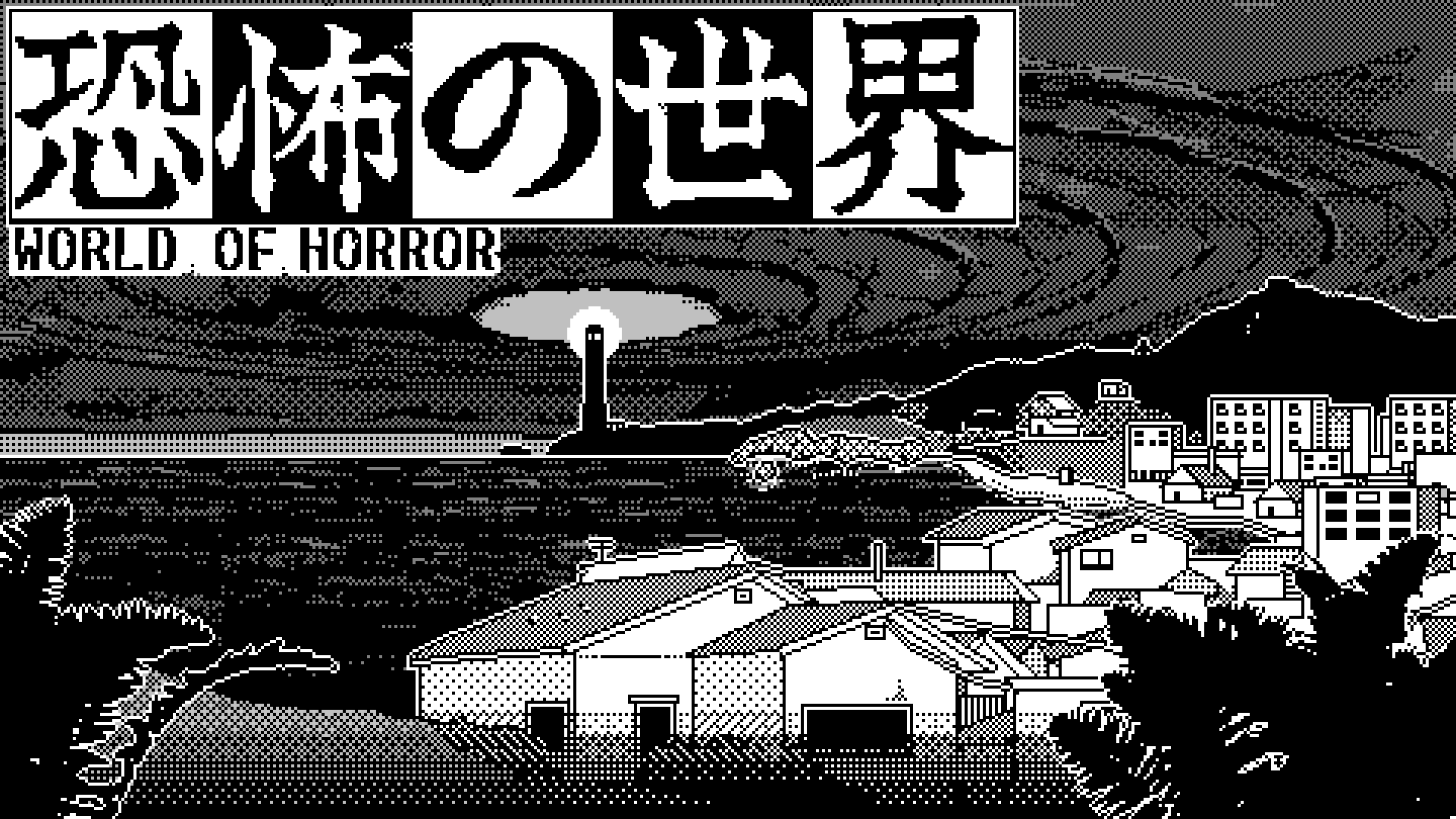
Anyway, this is a cute little horror pastiche. You should play it. That’s my take.
As it is a horror game, I should start with content warning. The game contains a pretty graphic depiction of an eye puncturing. It’s avoidable if you know what to do (go to a guide here, find the mystery with “eels” in its title. Ending A is the one you want to avoid), but it does prevent you from getting the best ending to one of the mysteries.
Other than that, the game mainly takes inspiration from Junji Ito’s work, so it tends to go for bizarre rather than gore. The old-timey “1-bit” graphic also serves to distance the player from the events depicted. Still, there are plenty of depictions and descriptions of various disturbing things, including bodily mutilation, so if it’s something that bother you, you may want to give this one a pass.
Overall, I’d say that if you’re OK with Uzumaki, you should be OK with WORLD OF HORROR.
Another thing that should be noted is that the game is currently in early access, so it has some bugs. Nothing game-breaking as far as I’ve seen, but minor issues can crop up. Otherwise, the game is fully functional. The full release is supposed to add some new content, but the game is basically complete as-is.
With all that out of the way, let’s begin review proper.
The basic premise of the game is that a cult has conducted a ritual on top of a lighthouse near Tokyo to awaken an ancient god (you get to pick which god to awaken, out of five. It determines a negative effect you’d have to deal with. One of them prevents running from combat, for example). You play as one of the characters who, by one twist of fate or another, became entangled in the occult and seek to prevent the completion of the ritual. To do that, you need to solve five mysteries (chose randomly at the start of the game out of pool of twelve) that are somehow connected to the ritual, then climb the lighthouse and hopefully save the day.
The gameplay is a bit hard to explain, so bear with me. You start in your apartment where you select a mystery to investigate from a cork board.

You then transferred to a town menu where you pick a region to investigate, like the downtown, the village, the mansion, the apartments, etc. This gives you a random horror-themed encounter with a couple of options to chose from.

Those options typically involve checks of your primary stats, with success granting some advantage, while failure usually damaging one of your HP counters. Either way, completing the encounter gives you some exp.
Sometimes you get a combat encounter instead.

The combat is turn-based. You fill the counter above with actions you want to take, like attack, dodge, etc. Once you fill the counter, you launch the sequence and execute all of the chosen actions in turn. Enemies generally just have one attack dealing fixed damage, though I think some have more elaborate attack pattern.
Interestingly, your stats don’t affect your actions directly. Weapons deal the same damage no matter your strength, dodge helps as much with low dexterity as with high, etc. Instead, increasing stats increases speed of actions tied to those stats, allowing you to do more in a single turn. It can get kinda ridiculous in late game if you focus on increasing a single stat and have an appropriate weapon (there are weapons keyed to strength, dexterity, perception and knowledge, with the latter two probably being the best because perception and especially knowledge also allows you to do cool stuff in random encounters more often than other stats), you can stack something like five-seven attacks in a row, shiving basically everyone to death in one or two turns. Getting to that point is another matter, of course.
Winning the combat gives you a large amount of exp. and, occasionally, some boon. (Ghosts drop ghost dust, which you can snort)
Either way, completing the encounter advances the plot. You get to read the next part of the mystery investigation and are told what to do next. Each mystery requires you to investigate a number of locations in a specific order, upon which you get the ending. There is usually, but not always, a boss fight involved. Those fights typically give you more options to chose from. For example, one mystery leads you to mysterious creatures feeding on dreams of comatose patients. You can switch off patients’ life support so their sudden deaths would damage the creatures. You can generally just fight the bosses the normal way if you’re squeamish about little murder, though, you big baby.
There is often an additional objective tied to a mystery (usually investigating a given location additional time or gathering rumors about the mystery or discarding a couple of items), which affects the ending.
Completing the mystery gives you exp., lowers your Doom (about it in a moment), gives one of the keys to the lighthouse and allows you to rest, healing up a bit of hit points. It also reveals a sign of the ancient god approaching, which generally means some bad global status effect, like tap water turning into black sludge, removing your ability to heal between mysteries. After that, it’s time to start a new mystery.
Completing one mystery is generally enough to gather 100 exp. and level up. It allows you to increase one stat by one OR heal up one of your HP counters (which is best avoided as there are other ways to do that, but sometimes there is little choice) and give you a perk. Most perks are just another stat bonus with flavor text attached, though some are more elaborate, like faster combat actions, free spell after completing each mystery, exp. bonus for each failed stat check, etc. Some perks also give you additional options in some encounters, but it’s too random to rely on.
There is more to do on the town menu, like visiting shops, going to a doctor if you’ve managed to get an injury, go to schoolyard to hear the latest rumors or recruit allies (they used to be OP in the demo since they were able to attack the enemy alongside you, action economy-ing everyone to death, but now, sadly, they just give you various stat bonuses. You can still throw them at enemies for some free damage, but they’d probably die), etc., but talking about them is mostly interesting if you’re already playing the game.
At its core, the game is about resource management. You have three counters to keep track of: Stamina, Reason, and Doom. Stamina and Reason are simply your HP: they’re lowered by failed stat checks and enemy attacks, and if either reaches zero, you die and would have to start over (you can’t save in the middle of a game without exiting). Doom is more interesting. It starts at zero and increases as the game progresses. If it reaches 100, the ancient god awakens completely and brings about the apocalypse, again ending the game. Doom is also essentially the resource you spend to do basically anything. Investigating a location costs doom, so does visiting shops and other helpful locations, and so does resting (which allows you to recover Stamina and Reason).
Doom is a pretty cool mechanic for this kind of game. It’s very easy to underestimate at the beginning, and for a couple of mysteries, it doesn’t really matter, but then you suddenly find yourself with Doom at 85% with another mystery to solve and realize you can’t afford to rest or visit the doctor or do anything but plunge ahead and hope you’ll make it (you won’t make it). I’ve died a lot to ancient gods nomming the Earth, more so than from Stamina or Reason loss (I’ve actually managed to never die to Reason loss somehow, I think the game is somewhat biased toward Stamina damage, especially in boss fights). It helps greatly to maintain the tension in later parts of the game, and makes it crucial to plan ahead instead of dealing with things as they come.
One other gameplay thing I should talk about is the magic system. It’s spell-based. Some characters automatically start with one or two spells, and you can research more in the library or get some from random encounters (one character actually has a perk to learn a new spell after each mystery). Spells have a variety of simple effects: damage to the enemy (and casting a spell doesn’t take time, so, hey, free action), heal Stamina, permanently increase a stat, or grant some bonus so long as you don’t cast another spell with a prolonged effect. The thing about spells, though, is that it costs Reason (and thus, ultimately, Doom) to cast, which, honestly, is generally just not worth it. There is a couple of spells you may cast in desperation because it’s either that or dying right now, and a couple of spells (mostly permanent stat bonuses) that are actually useful if your reason is high enough and the end of mystery is near, but generally, it’s better to just not touch them.
In fact, the best thing you can do with a spell is to forget it, as it restores a point of Reason, so, hey, free healing.
Picking one of the gods actually makes it so casting spells costs Doom instead of Reason, which is actually generally more forgiving, but even then you wouldn’t want to rely on spells as anything other than an occasional boon. Which is a shame since they’re generally fairly flavorful and cool, they’re just not worth the price.
I suppose, in a Lovecraftian horror like that, magic not being worth it could be the point (IIRC, that was explicitly a design goal in Call of Cthulhu), but, honestly, that just means there is this cool thing you’re encouraged to never touch, which seems counterproductive to me.
The game takes about an hour to complete (less at first since you’re going to die), but has great replay value. You have several characters to pick from, each with their own gimmick, more characters to unlock later, there are achievements to get that allow you to add new features to the town (like the Monolith, which presents a rare opportunity to lower Doom in exchange for various sacrifices) and, of course, twelve mysteries and their various endings to uncover.
Well, that’s about it for the gameplay.
Speaking about the game as a whole, I would describe it as charming. It is, first and foremost, a loving homage to works of Junji Ito, Lovecraft and other horror classic (particularly Japanese horror, of course, given the setting and the art style). It’s not particularly horrifying, in large part because of how abstract it is. The mysteries are one step removed from you: you aren’t engaged in the investigation proper, but deal with random encounters and are told afterwards how your investigation is going. And the mysteries aren’t really connected together: solving them makes someone deliver keys to your mailbox, but you don’t learn how a scissor woman appearing in your school helps to usher the awakening of an ancient god.
(This, of course, can be seen as a negative compared to more immersive horror games, and I do appreciate mysteries that break the mold and take you away from the familiar city menu into more thematically-coherent location. The Vigil mystery is a real standout here: it’s about your distant relative suddenly passing away, and you being summoned to the extended family gathering to participate in a nightly vigil over his body. You get to explore a mansion with specific rooms you can unlock and revisit, and actually enact part of the ritual until his body goes missing. It still follows the same overall structure, you still deal with random encounters, but they’re more specific to the setting and all take place in a confined space, making the mystery more atmospheric.)
The game is primary a vehicle to deliver cool snapshots of homages to horror classics, and I think it works great if you’re a fan of Junji’s works, but it may leave outside audience somewhat cold.
Still, it has a cool artwork, fairly robust mechanical foundation, and it’s short while providing great replayability, so give it a try.
It’s not like you can go outside, anyway.

This seems amazingly cool! Is it a fangame, or something more… I suppose “professional” would be the word?
It was done by like one guy working in MS Paint, but the result is a fairly professional. It can probably be compared to Undertale in that it’s primary a passion project of one person resulting in a fully commercial game.
You can find a demo on itch.io if you want to check it out, though it’s not actually particularly representative of the finished game in terms of gameplay: aside from updated mechanics, it presents you with one mystery at a time, which makes Doom toothless.
Not all spells cost Reason, actually! There’s some with other requirements, and honestly spending some Reason or Doom for permanent stat boosts is a pretty good trade.
Yeah, permabonuses is about the best thing you can get out of magic. And yeah, some spells cost Stamina instead, and at least one takes all three counters for 8 damage.
I just kinda dislike that magic is pretty situational and not something you should make a major part of your strategy despite one character revolving around it and having one of the best outfit (the trenchcoat brigade one). I enjoy playing as a mighty wizard.